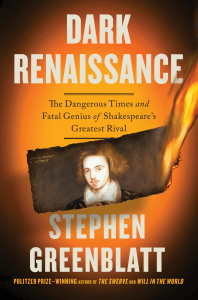
 As the title suggests, Stephen Greenblatt’s new book isn’t so much an exhaustive biography of Christopher Marlowe as an expert rendering of the world he lived in. Dark Renaissance, The Dangerous Times and Fatal Genius of Shakespeare’s Greatest Rival is a necessary correction to the Masterpiece Theater visions of this era. It was a time of tremendous wealth and prosperity—for the few. The remaining ninety-five percent lived in poverty—even squalor. Mr. Greenblatt provides just enough descriptive detail to inoculate the reader from any false sentimentalization of that time. Suffice it to say, human sanitation is an ongoing issue, the bubonic plague is lurking, and the country is being run by an authoritarian ruler who uses the rack, public executions, disemboweling, castration and other cruel and unusual punishments to enforce her religious rule. It was a cold time literally and figuratively—a ‘little ice age’ was plunging temperatures and threatening crops. Against this backdrop, perhaps it is not surprising that upward mobility was actively discouraged—and nearly impossible.
The story of the rise of a cobbler’s son to the most esteemed playwright of his time makes a fascinating read. It is widely accepted that Christopher Marlowe was queer. But of course it would have been impossible for him to be out–in a time when the buggery laws still carried a death sentence. Nevertheless, Mr. Greenblatt doesn’t skirt this subject. He points out the homoerotic aspects of Marlowe’s work—particularly in Doctor Faustus. For this queer reader the most startling revelation of this book was that Marlowe and Shakespeare collaborated on Henry IV. And Mr. Greenblatt even imagines some of the conversations they might have had about Shakespeare’s greatest love, Henry Wriothestley. But of course, that is all we can do: imagine. Mr. Greenblatt doesn’t reveal any long-lost love letters or anything of that sort. Indeed, none of Marlowe’s letters have survived–not surprising since the crown constantly opened and read personal correspondences.
Above all this book is a tribute to Christopher Marlowe—a playwright who is often overshadowed by Shakespeare, but who was, in reality, one of his greatest influences. Mr. Greenblatt is a scholar of this subject and he takes the time to explain it all to the rest of us. The literary significance of Tamburlaine and Marlowe’s ground-breaking usage of unrhymed verse are explored, as are the origins of Doctor Faustus. But for this queer reader the most fascinating part of this story is the unlikely rise and sudden horrifying fall of this great queer author.
Had it not been for a miraculous scholarship to King’s School and then Cambridge, Christopher Marlowe would have probably ended up a shoemaker like his father—if he were lucky. Instead, he entered London’s theater scene as a gentleman and a scholar. Fluent in Latin and Greek, well-versed in the classics, he had access to books and manuscripts others didn’t. Perhaps it isn’t surprising that this singular young man would go on to write seven ground-breaking plays, along with some verse that still resonates today. What is surprising is that he did all this before his death at the age of twenty-nine.
We will never know precisely why Christopher Marlowe was stabbed to death at such a young age. The official explanation that it was an argument over a bar tab has largely been debunked. Mr. Greenblatt makes a strong case that the queen and her advisors were behind it, but this case is circumstantial. It is, of course Christopher Marlowe’s works that matter. Celebrating them, explaining them and putting them into context is Mr. Greenblatt’s job here. And he does it beautifully.
Needless to say, QueerReader strongly recommends this important book.
Stephen Greenblatt’s Dark Renaissance, The Dangerous Times and Fatal Genuis of Shakespeare’s Greatest Rival is published by W.W. Norton.
December 3, 2025